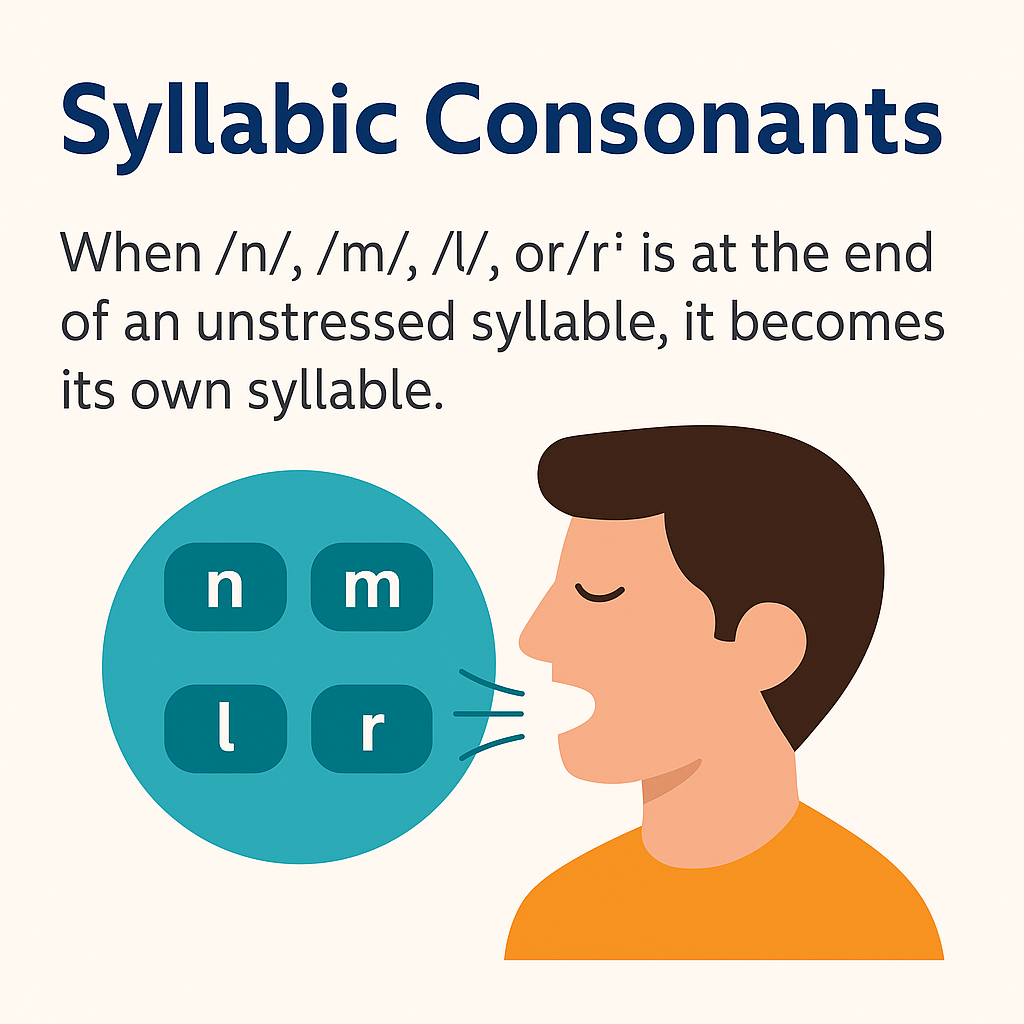
In American English, native speakers often drop the vowel in an unstressed syllable — especially before sounds like m, n, l, or r. This creates what’s called a syllabic consonant, where the consonant becomes the syllable itself.
If you pronounce every vowel, like in “problem” or “author,” it might sound correct to you — but it doesn’t sound native. This video explains exactly what’s happening — and how to fix it.
In American English, syllabic consonants happen when /n/, /m/, /l/, or /r/ carry an entire syllable without a vowel sound. That means you might see a second syllable in writing — but there’s no vowel sound there at all.
This isn’t optional or informal — it’s how native speakers talk in every situation, from everyday conversation to courtroom testimony. Trying to insert a full vowel sound into those syllables makes your English sound unnatural, harder to follow, and frankly, just wrong.
Click any word below to hear how native speakers actually say it. These words all end in syllabic N, M, L, or R — which means the vowel in the final unstressed syllable disappears completely.
In fast speech, the first vowel often relaxes into a quick, unstressed sound — especially in common prefixes like com- / con- / col-. Click to hear real examples:
Perfect daily practice (25 min/day) before or alongside my 1:1 executive coaching.
25 courses • 600+ videos • 40,000+ audio files
I only recommend programs I’ve personally reviewed and believe will genuinely help immigrant tech professionals sound confident in U.S. meetings, standups, and client calls.